
Summer Sale | All Fragrances 70% OFF Sitewide
Free Worldwide Shipping On Every Single Order


Couldn't load pickup availability
Free standard shipping on orders
We are pleased to offer Free Worldwide Shipping on all orders, delivering to all countries and regions supported by our logistics network.
There are no restrictions on order quantity, parcel size, or shipment weight — every order ships at no cost to you. In addition, all customs duties, import taxes, and government-imposed fees associated with your shipment will be fully covered by us, ensuring you will not incur any extra charges upon delivery.
Please note that delivery times may vary due to local customs procedures and carrier conditions, but your shipping and customs costs will remain completely free under this policy.
We provide a secure and reliable Free Returns service for all customers. Items that remain unused and unopened may be returned within 60 days for a full refund.
All return shipping expenses, including customs-related fees, are fully covered by us.
Refund processing will be completed within 4 weeks from the date the return shipment is sent, regardless of whether the package has arrived at our facility. In general, refunds are finalized significantly earlier, ensuring a smooth and dependable experience.
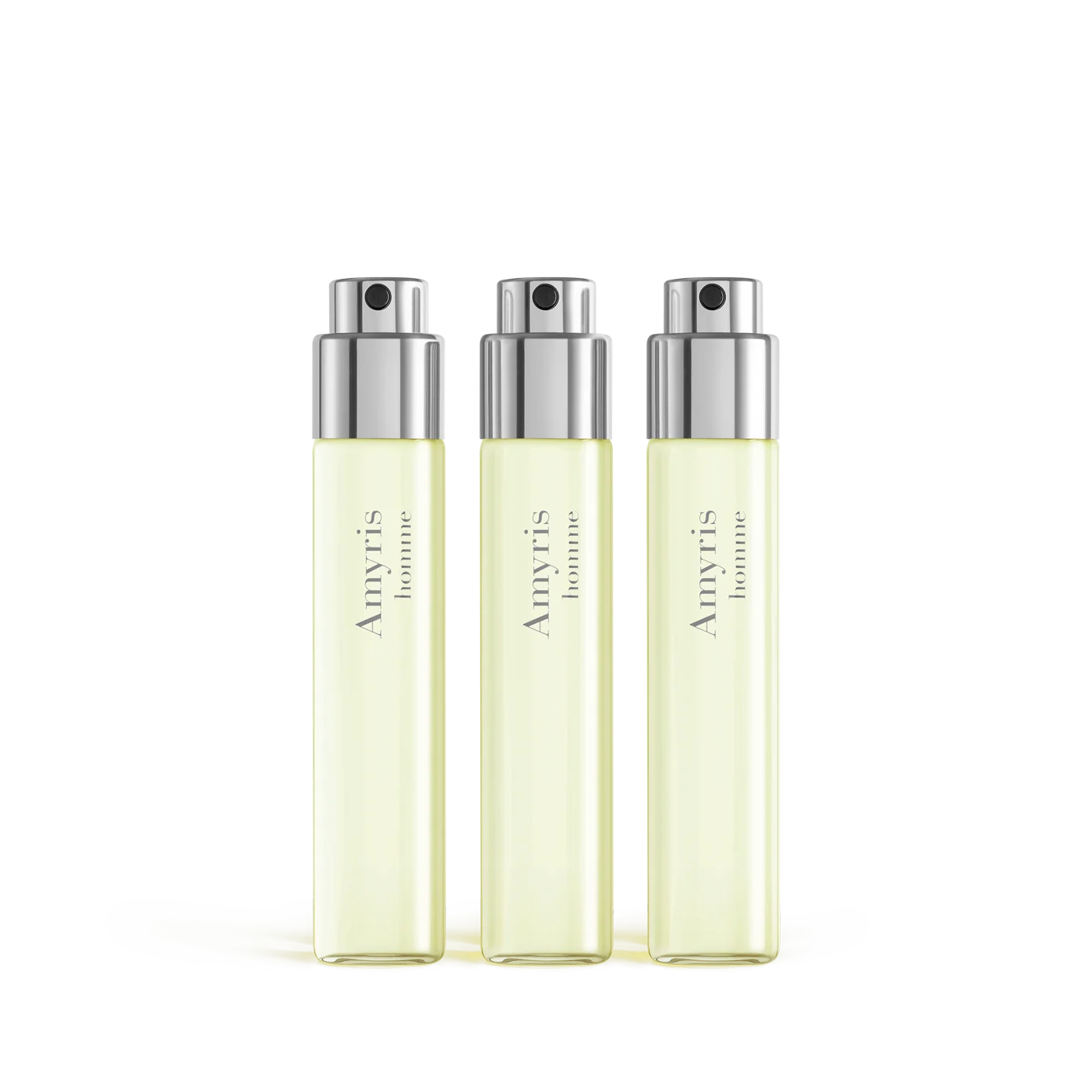
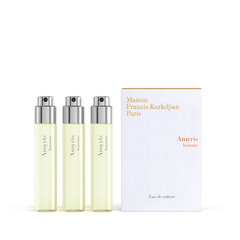
Amyris Maison Francis Kurkdjian eau de toilette for men is a masculine take on the flamboyant pair created by amyris and iris. Simultaneously fresh and woody, this fragrance places you in a whirlwind of scents, with aromatic notes of mandarin and rosemary warmed with a tonka bean absolute. Amyris eau de toilette for men, a captivating and luminous fragrance.
This Citrus reticulata was imported from Asia at the beginning of the 19th century. According to legend, its name came from its color, identical to the ceremonial dresses of Chinese Mandarins. The fragrant compounds contained in its peel are extracted by cold expression to obtain its oil. This variety has citrusy, zesty but also green, sweet and slightly sulphurous facets. This sparkling and joyful top note enhances a Cologne and energizes an ambery perfume.
Endemic to the Mediterranean region, this shrub was already highly prized in the Middle Ages, and cultivated by monks in gardens of medicinal plants; it was used as an antiseptic and a tonic, among other things. Mixed with alcohol, Rosmarinus officinalis was also the major component of the Queen's Eau de Hongrie in the 14th century, renowned for its alleged rejuvenating properties. The oil is obtained after distillation of its blooms. It has fresh, aromatic, herbaceous, camphorated and slightly woody inflections. As a top note, rosemary is used in the composition of some colognes and in many men's fragrances.
Coming from the pistil of a variety of crocuses, this most expensive spice in the world is nicknamed "red gold". Natural saffron is not used in perfumery because it contains safrol, a highly allergenic compound. But its effect is reproduced with one of its derivatives, saffronal. Its very powerful perfume is bitter and slightly metallic, blowing hot and cold on the rest of the composition with also a leathery, tarred facet. Francis Kurkdjian likes to use it in the top layer of a fragrance to break the sweetness of citrus notes. It is often associated with Oud-based perfumes and amber accords.
Its name sounds like that of an Egyptian goddess and yet it is native to the Caribbean. There, local fishermen poetically call it "candle wood" because they use it as torches thanks to its highly flammable properties. It is sometimes also refered to as sandalwood from the West Indies. This is probably because once distilled, Amyris balsamifera exhales sweet scents that oscillate between cedar and spicy, slightly smoky sandalwood. A classification among woods that clashes with its botanical genus, the rutaceae family, which also comprises citrus fruits.
As its name suggests, it belongs to the woody family. It intervenes in the heart and in the base, which brings a sort of verticality to the perfumes. In perfumery, we can use different types of cedar with more or less accentuated olfactory facets. The most commonly used is Virginia cedar, Juniperus Virginiana, with the typical odor that emerges when sharpening a pencil: woody, dry, slightly spicy and creamy. It is quite different from the two other major varieties used in perfumery, Texas cedar, which is drier, and Atlas cedar, which is animal and leathery.
This precious raw ingredient comes from the Dipteryx odorata, a tree endemic to Central America and northern South America. Local people have to go into the jungle to pick its ripe fruit once fallen to the ground. After macerating in alcohol and dried, it delivers its kernel, a wrinkled black bean, the tonka. It gradually develops its flavors, including those of its main aromatic molecule, coumarin: powdery, almondy with a freshly mown hay effect, tobacco, slightly honeyed and smoked. Its gourmand facet evokes a slightly vanilla-scented and sweetened shortbread tart. Its absolute, obtained by volatile solvent extraction, is one of the most sensual base notes.
If in the hearts of perfumers the rose is the queen of flowers and Grandiflorum jasmine the king, then the iris is the empress. The part utilized in fragrances is not its flower, but its rhizome, i.e. its root. Perfumery uses the iris pallida, native to the region of Florence in Italy. After growing in soil for 3 years, the iris rhizomes are dried and crushed before being distilled to obtain an oil with a thick consistency, also called iris butter. This long transformation process and the very low yield it produces make it one of the most expensive ingredients in the perfumer's palette. The iris extract offers a very special floral note, between the violet and a soft wood, with very powdery and slightly chocolatey, cocoa-like facets. Endowed with exceptional persistence, the iris can be used in minute doses to add volume or in greater quantity to support a floral or woody accord.
ALCOHOL; PARFUM (FRAGRANCE); AQUA (WATER/EAU); BUTYL METHOXYDIBENZOYLMETHANE; TETRAMETHYL ACETYLOCTAHYDRONAPHTHALENES; CITRUS AURANTIUM BERGAMIA (BERGAMOT) PEEL OIL; HEXAMETHYLINDANOPYRAN; LINALYL ACETATE; LIMONENE; JUNIPERUS VIRGINIANA OIL; HYDROXYCITRONELLAL; LINALOOL; COUMARIN; PINENE; CITRUS LIMON (LEMON) PEEL OIL; VANILLIN; ROSE KETONES; CITRAL; CINNAMAL; BETA-CARYOPHYLLENE; GERANYL ACETATE; CAMPHOR; TERPINOLENE; TERPINEOL; ALPHA-TERPINENE; EUGENOL; GERANIOL. - 2F314
WARNING: THE INGREDIENTS THAT ENTER IN THE COMPOSITION OF THE MAISON FRANCIS KURKDJIAN PRODUCTS ARE REGULARLY UPDATED. BEFORE USING A MAISON FRANCIS KURKDJIAN PRODUCT, PLEASE READ THE INGREDIENT LIST ON ITS PACKAGING TO ENSURE THAT THE INGREDIENTS ARE SUITABLE FOR YOUR PERSONAL USE.
PRECAUTION FOR USE: THIS PRODUCT CONTAINS NATURAL EXTRACTS. THE PRESENCE OF SUSPENDED PARTICLES OR COLOR VARIATIONS DO NOT ALTER ITS QUALITY IN ANY WAY. PROTECT FROM DIRECT LIGHT AND SOURCES OF HEAT.
Thanks for subscribing!
This email has been registered!